

The Latin America Education is always based in the European tradition, forgetting
the roots of our culture. The uruguayan artist Torres García and my mentor was the
encouraged his students to find an artistic tradition in South American cultures. This
investigation created a new consciousness of artistic-cultural identity, becameing a source
of a new symbolism with will enrich the Art world.
When I arrived to teach Fine Arts at Altos de Chavón School of Design in the
Dominican Republic, I I had the opportunity to teach Fine Arts in the Dominican Republic,
at Altos de Chavón School of Design, were I found a culture full of colorful traditions. In
order to explore these traditions, my students and I started projects related to myth,
legends.
My objetive was to make the students awere of their richness of their own traditions, to
respect and incorporate them to own art work.
In the class of Three Dimensional Design we did different projects. using as
motivations Art history, Present Concerns and the Dominican Traditions.
For example, in the project ” Pop Up Books” the instructional objective was the
translation from two dimensional to three dimensional image departing from a
conventional two dimensional image, each group had a different period to chose from; the
Rennaissence or Modern Painting. The student’s aim was to recreate the space.in a
logical sequence with the original work, while in the process interpreting art History Like
in one project they had to interpret the painting by Velazquez, “Las Meninas” into a stage
pop up piece.
To relate the student with present concerns, we touched upon the problem of the
environment, the point of departure was a word related to Nature. From there, they
developed their own concept creating a maquete, for a Museum Installation.
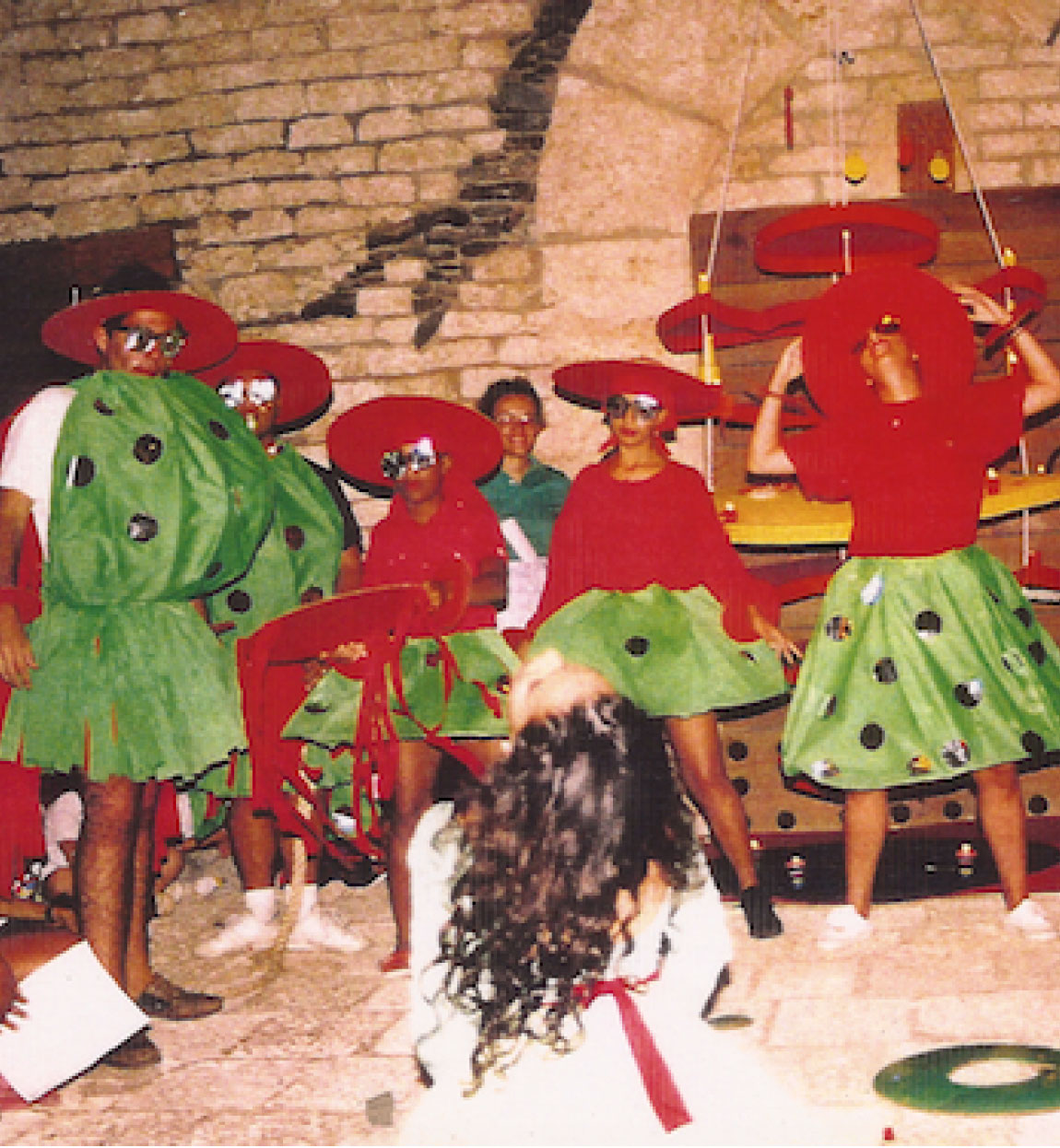
The performance was the last phase of our tree dimensional studies. In this project
we incorporated the tradition of the GAGA.was a complete three dimensional experience
where the students were an active part of their own piece.
The Gaga is a religious celebration from the Dominican Republic representing the
syncretism of African and European.cultures This popular celebration takes place every
Saturday of February in the “Bateyes”[1] . Drums, “fotutos”[2] and singing. are heard But
the peack of these celebrations start on the Thursday night of the Holy Week, a very
colorful dance starts until Eastern Sunday, working and dancing from bateye to bateye.
The origin of this celebration could be in the cost of Guinea or in the Congo, and can be
related to fertility, their ancestors or the African god Din.
In the “Gaga Geometric” we penetrated the space. acting as living sculptures interacting
in our own created space. and also expanding the space and thus linking ourselves with
the audience, while provoking their participation. This project combined fluency of ideas
and use of materials that the students had already experienced in past projects.
The transgression of the ritual, magic and religion to the modern art format, gave us
new formal art components like rhythm, space, and colors. The traditional Japanese
Theater was the first to incorporate its rituals to the visual arts. But also Modernism
appropriated itself of the formal components of African Art as innovative elements for the
revitalization of a waning European artistic tradition, in the case of the Cubism and
Surrealism.
In our geometric interpretation of the GaGa, we fused elements from the African
tradition together with the European modernist art tradition. We were inspired by different
movements and artists of Modern Art, such as Cubism ( Picasso and Braque), Surrealism
(Max Ernst), Bauhaus (Schlemmer, with the costumes for the “Triadic Ballet”).and by the
artist Wifredo Lam, who went much further, using his syntax to visualize his interpretation
of the Cuban religion call “Santería”, a blend of Catholic liturgy with African Religions. The
art history is an esencial tool to help the student to see the artist relation with culture and
time and how they interpreted their world.
The Transgression of the tradition Into Fine Arts
The motivation. First we introduced the GAGA with a lecture by the Sociologist Dagoberto
Tejeda. This activity was organized together with the Museum of Archeology and
Anthropology of Altos de Chavón.
Dr Tejeda’s presentation opened a new world to the students and to the general
audiences. He presented the Gaga as a representation of a social political and artistic
event, well known by Dominicans but denied by the establishment. He introduced to us to
a fantastic world, of symbols represented by colors, attributes (colored scarfs, flags and of
course a lot of rum drinking to stimulate the participants) and a very sensual dance of
African rhythm. All these elements made this point of departure very appropriate for our
project. Also we lern that a Gaga start in an altar, wich is a small room with a lot of
colorfuul elements
Colors have their own symbolism in this popular religion, each one representing
spirits (“luases”) and saints. Red represents Petró ( a spirit), who is Saint Cristobal; blue
is Ogún Balenyó who is Saint Santiago, and yellow is Anaisa or Saint Ana. This African
symbolism, “popular codification”, according to the sociologist Dr. Dagoberto Tejeda, is
coded into different aspects of culture as we see it represented in different symbolic
forms This symbolic references are related to the world of nature, and will be a greate
asset for our project.
The Gaga has also bad connotations, for part of the Dominican society. It can be
regarded as a “primitive”(in the negative sense) expression, to sensual, a symbol of
scandal.. That way we have to clarify our parameters. We take this cultural expression as
a tradition that links us with our roots. We don’t have to look at African art, like the
modernists did, we have that treasure in us, and should express it in the content of the
aesthetics.in contemporary art.
The Gaga is the result of “promisees”.they did to the “luase”, the participants are
divided in ranks . The head of the gaga is called “the owner” or the Horse” because he
received the spirit. The queen and The Mayors and the musicians, each character has an
special costume, Generally the “Owner” is dressed in the color of the luass, and the
“queens” use the same color dress with and a veil,they put a lot of makeup, The “Mayors”
wear capes with mirrors and color ribbons and in the waist as big skirts made with colored
scarfs. The musicians play a very contagious rhythm with trumpets and the fotutos with
very sensual lyrics, appropriate for the dance
The Owner or the first “Mayor” uses the whip and the whistle to separate the crowd and to
create a magical moment. The mayores also use a cane to dance in the ceremony
Also as part of the motivation the studens researched about performances in the
School Library. We discassed the works of Shlemmer in the Bauhaus, and the works of
the conseptual artists: Ana Mendieta, Marta Menujin, Ralf Ortiz
Description of the project: The Geometric Gaga.was a group project were the three
classes of “Three Dimenssional disign partisipated. Each class with aproximatly 20
students.was divided in groups of 5 students The project took us 4 weeks
As the title of the project anunce we translate the “Luases” of the gaga to the
primary geometric shapes an forms, Circle, Squere, Triangle-Cube, Esfera and Piramid
adding the organic form, to breaque the geomery tention. And we had to use the colors of
the traditional gaga One of the classes made the altars, selecting elements from the
Popular altar and adapting them to the geometric forms that each represent., we had four
altars. one for each geometric form. The gaga Groups 2 of each form but only one of the
organic form. They have to create their own costums and coreografy departing from the
traditional “luas” arriving to their geometric form. Also each group have to inpruve the
numbers of participants, they asked to the class dooing altars and the students from
secon Sophmore to join then. So this project by my sorprise became a school project.
Investigacion de Campo
The following step after hearing Dr Tejeda’s lecture was to actually attend a
Gaga.performance. we were fortunate because the school is located right in the middle of
a sugar cane plantations where these perfomances take place.
We divided in grups, one group of 15 students atended the Gaga ceremonies in the
diwn of Good Friday at “Palo Blanco” bateye. This group came back to the dorms very
exited, I can forget their expression, and their exitment, they were cover with mad, was
raining for same time and the bateyes are litle villas in the midle of the sugar cane
fills They started explaning to me all at the same time about, the colors, the music, the
mistery and all in detail about the altar, the costums. Tejeda’s son and they met one
of the queens and she explein all about her “Promess” and that her dress was broth from
New York special for the ceremony . The students were prepard to look, to do a dip
deconstruction of the ritual.
Ideas started poping up for their project, until they realised that, they want to shere
them with their group only. From then on they were redy to start their own Geometric
Gaga-Altar. Departing from their betey they walk an dance until Sunday visiting all the
bateyes and towns of the area, you can actualy see them on the roud from the bus, that
was my first encaunter with a Gaga Group an year ago, with make me look for more and
later creat this project.
Other groups visited the beteyes of La Ceja, Higueral, Guaymate (Where I was luky
to see three diferent gagas), and San Pedro de Macoris until Sunday when the celebration
ended.
For the students and myself the experience was unique. The incredible hability of
doing costumes.and music instruments whith very pour materials
geve us ideasto used there sources as inspiration for our own compositions.