

NY 1993
Common Sources of Spiritualism in the Work of Piet Mondrian
and Joaquín Torres-García
In these pages I wish to explore the similarities and differences in the work of two important
artists of the first half of this century. These comparisons were inspired by the exhibition
Circle and Square: Geometric Abstraction and Constructivism in the Americas, 1934–1950,
at the Kouros Gallery in Manhattan.
Both Torres-García and Mondrian struggled throughout their lives to achieve a vision. What
I will examine here are some of the beliefs, readings, teachers, and other artists that served
as points of support, inspiration, or reaction in their search for full realization.
Both were path openers (although due to Torres-García’s isolation in South America, the
importance of his work is only now beginning to be fully understood). What makes their
contribution to modern art so interesting is not only how they converged in many ideas, but
also how they differed in others. They met in Paris in 1929, becoming devoted and
respectful friends and admirers of each other’s work. Even when Torres-García left Paris in
1932, he and Mondrian stayed in touch through correspondence until 1938, when Mondrian
left Paris for London. From Montevideo, Torres-García dedicated his book Estructura
(1935) to Mondrian and published many articles about him.
Symbolism and Theosophy in Mondrian
When Mondrian finished his studies in 1899, he experienced a religious crisis. He even
considered becoming a priest before fully dedicating himself to art. He attended many
theosophical lectures. Through Theosophy, Mondrian could abandon the strict Lutheran
principles of his upbringing.
In the summer of 1908, Mondrian met Jan Toorop in Domburg. Toorop was one of the most
important Dutch Symbolists, influenced by the English Pre-Raphaelites, as well as the arts
of Egypt, Assyria, Japan, and Indonesia. He later converted to Catholicism. His work drew
on fantastic symbolic imagery, inspired by contemporary Symbolist writers. He was also
very interested in the poetry of the American Walt Whitman, as Torres-García would be
later.
In Domburg, Mondrian painted the triptych Evolution, a perfect example of Toorop’s
influence. In this work we see Mondrian’s new interest in spirituality and mysticism, which
led him toward Theosophy. On May 25, 1909, Mondrian became a member of the Dutch
Theosophical Society. That same year he wrote to Israel Querido (critic and writer): “It
seems to me that clarity of thought should be accompanied by clarity of technique.” This
reveals how important Theosophy was in shaping the artistic form he would later develop.
By 1911, Mondrian met the painter and critic Conrad Kickert, who brought the first Cubist
works by Braque and Picasso to Holland. That same year they collaborated in organizing an
exhibition of Cubism in Amsterdam. Cubism deeply influenced Mondrian, helping him
advance his search for the geometric essence of Nature, while still maintaining his
theosophical concepts of art and life.
In a dialogue with Theo van Doesburg in 1917, Mondrian said: “I got everything from the
Secret Doctrine (Blavatsky).” and “When I look through the canvas; when I pass through a
wall, what will I then still see on that canvas or on that wall?” Was he implying that he was
seeing matter or the structure of the atom? More likely, Mondrian was alluding to the
theosophical concept of involution, during which billions of units of spiritual consciousness,
called “monads,” emerge from the ONE undifferentiated Source, becoming more and more
involved in matter—through the mineral, vegetable, and animal kingdoms.
What comes through in these ideas is the desire to integrate the structure of art with the
structure of the universe, to achieve the same unity found in Nature: “Seeing the sea, sky,
and stars, I represented this through a multiplicity of crosses. I was impressed by the
greatness of nature and tried to express expansion, rest, unity.”
These canvases of 1914 marked a crucial stage in Mondrian’s evolution—from the painterly
Cubist compositions of 1912 to the pure constructions of color and line of 1919.
Puvis de Chavannes and Neo-Classicism in Torres-García
Torres-García arrived in Barcelona in 1891, at a time when Modernism was fashionable in
Europe. Steinlen, Toulouse-Lautrec, Munch’s Expressionism, Romanticism, and Art
Nouveau’s decorative style all had great influence. For a time, drawing in the style of
Toulouse-Lautrec offered Torres-García a liberating experience from the academic methods
taught at the Academy.
Reading Greek philosophy and studying the work of Puvis de Chavannes were crucial in
helping Torres-García escape the dominant decorative and academic trends in Barcelona at
the turn of the century.
In 1904, Torres-García wrote an essay titled Angusta et Augusta, praising the Mediterranean
roots that Catalans shared with classical Greece. Neoclassicism for Torres-García played a
similar role to Symbolism for Mondrian: both offered a return to order and strong roots.
Mondrian sought in Theosophy what Torres-García sought in Plato—balanced and timeless
foundations from which to elaborate their visions.
By 1911–12, both had their first encounters with Cubism: Torres-García at the Galeries
Dalmau in Barcelona and Mondrian in Amsterdam. In 1913 Torres-García published Notes
sobre Art (Notes on Art). In a chapter titled Structure, he wrote:
“For the artist, before form and color there is the organization of things, its structure.
Because color and shape are for him the manifestations of an idea. The idea is rather the
justification of that color and that form. In this way you can look at the appearance of things
as the Impressionists do, or go to the essence, so that works will come forth from
understanding and not from the sensory impression of things.”
Structure
For Mondrian and the Neo-Plasticists, structure was a process distilled in various stages of
reduction—from a faithful representation of reality to an elemental, pure structure of
horizontal and vertical lines. The theoretical foundation was the philosophy of M.H.J.
Schoenmaekers, the Dutch thinker who sought a mathematical and geometric basis behind
appearances.
Torres-García, although working from a different perspective, also arrived at the idea of
structure as essential. His paintings are “constructive,” in what he later called Universal
Constructivism. Even when his work contained recognizable images (a mason’s tools, the
sea, a tree), he reduced them to essential forms, always within a structural framework.
Beginning in 1916, Torres-García used a system of color planes dividing the canvas into flat
compartments, more like a graphic drawing than a shaded or volumetric representation. This
structure unified diverse elements into a single order.
What took Torres-García longer to resolve was the inclusion of symbols within this
structure—taking a step further from Neo-Plasticism. For him, the absolute purity achieved
by Mondrian led to a dead end: “Man’s soul has to be included in art, not excluded.”
As Clement Greenberg once wrote: “Mondrian committed the unforgivable error of
asserting that one mode of art, that of pure abstract relations, would be absolutely superior
to all others in the future.” Here is where Torres-García diverged. He was committed to a
balance between intellect and emotion. He wanted to include the whole of nature, as the
image and representation of creation and the microcosm of universal order. Geometric
abstraction alone was not enough to express his worldview. His Universal Constructivism
encompassed rational structure, emotion, intuition, and symbolic references to the natural
world.
Analysis of Two Works from the 1940s
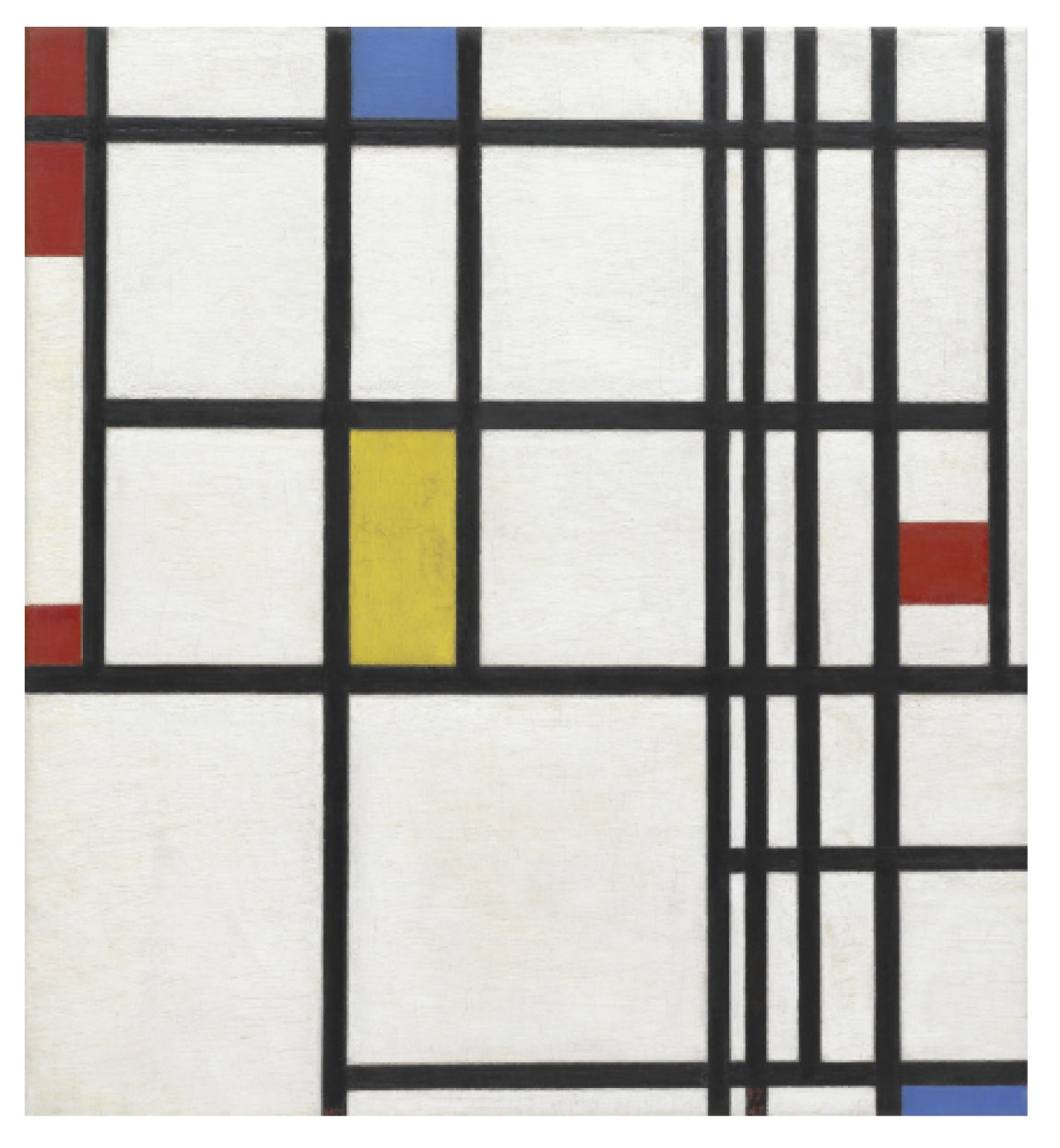
Piet Mondrian – Composition in Red, Blue, and Yellow (1937–42)
Oil on canvas, 23 3⁄4 × 21 7⁄8 in.
The Museum of Modern Art, New York
This composition suggests a cityscape, divided by a low horizon. The placement of the
second horizontal line gives the impression of a high, bright sky, expressed by the red and
the blue. The yellow evokes Dutch canals.
Imagining a landscape in such an abstract work is not far-fetched. In his dialogue Natural
Reality and Abstract Reality (1919), Mondrian imagines a conversation between an amateur
painter (Y), a figurative painter (X), and an abstract painter (Z, himself). Speaking about
landscape, Z says: “The feeling of rest becomes plastically apparent by the harmony of the
relations and that is the reason to accentuate the expression of relations. We express
ourselves plastically by opposing colors and line, and this opposition creates a harmonious
relation: proportion and balance.”
The painting conveys a vertical rhythm through the repetition of four close vertical lines
crossing the canvas from top to bottom, forming sixteen different rectangles. The absence
of symmetry introduces a subtle vibration, a total experience of air and movement that
surprises the viewer. Our tendency is to expect equal spaces, symmetrical repetitious,
Mondrian tricks us with things we will never expect.
The black bars, varied in thickness, create a transparent grid that gives an extraordinary
sense of space and light, suggesting infinity—the eternal. Here we see Mondrian’s
Theosophical ideas.
He never uses diagonal lines, except in works where the framework itself is set diagonally,
such as Painting I (1926), from the collection of the Museum of Modern Art, New York.
Nevertheless, a sense of diagonal movement can still be perceived through the intersections
of the black bars and the relationships between colors. For example, in this work, the red in
the upper left corner connects through the yellow to the blue in the lower right corner, just as
the top blue relates to the red on the right. These interactions create a rotational effect within
the structure, suggesting to the viewer the movement of the earth.
Also, Mondrian moves us upward into the high Dutch sky through progressive steps toward
the red on the right, then turning diagonally through the crossing points toward the blue.
This relationship between metaphysics and mathematics is what sustains Mondrian on the
verge of a humanistic feeling. I feel that he will lose this balance in his later paintings, such
as Broadway Boogie Woogie (1942–43), from the collection of the Museum of Modern Art.
It is too uniform, becoming almost a computerized image, where spaces are repeated. Here
he failed, becoming cold and almost frivolous. Yet, from the artist’s perspective, he
succeeded in his purpose during his final years: to break with nature. As he said to Torres-
García, “I am not interested in the least in nature.”
Clement Greenberg, writing in 1943 right after the purchase of Broadway Boogie Woogie by
MoMA, observed: “The picture has a floating, wavering, somehow awkward quality; the
color wanders off in directions that I am sure belie the artist’s intent. It is a remarkable
accomplishment, a failure worthy only of a great artist.”
Joaquín Torres-García – Constructivist Composition (1943)
Oil on canvas, 26 × 30 in.
OAS AMA, Art Museum of the Americas Collection gift of Nelson Rockefeller, estate of
Torres-García
The overall impression of this work is suggestive of a harbor cityscape, Montevideo. In the
bottom left corner, the earth-red plane could be interpreted as a path or pier leading to the
blue waters of the sea or a river, which takes us through symbols related to fishermen and
sailors. The ship has many meanings; for me, it could represent the interchange with the Old
World. Through the ladder, we ascend to an urban scene: the city in autumn, where the
Universal Man belongs. Seeing all these symbols together, Torres-García takes us from the
common elements of human consciousness, opposed to the everyday aspects of human life.
The Universal Man and the boat, the scales, and the train; the ruler, and a machine.
In this composition, the colors are basically the same palette as Mondrian’s—yellow, red,
blue, black, and white—but in Torres-García’s painting they are earth colors, toned with
white and black. The planes of color follow an independent structure from the predominant
grid, as if the two were juxtaposed. The surface of the work is divided into compartments
measured by the Golden Mean. In this particular work the grid is asymmetrical, but in many
earlier works by Torres-García the structure is symmetrical.
The point of departure that determines the center from which the grid evolves is the crossing
point between the horizontal and vertical of the orthogonal plan. In this picture, it is the first
step of the ladder on the right-hand side. From this center, the lines of the grid evolve, never
crossing each other. In both Mondrian’s and Torres-García’s painting, the basic abstract
elements—line, dimension, and color plane—are used as intrinsic values independent of any
representation.
Now, Torres-García’s symbols inside each compartment are not representations but ideas. A
symbol is form and idea in one; therefore, the elements do not belong to the real but to an
aesthetic order. “The image or symbol inserted in a given compartment of the grid was
dictated by the size and shape of the compartment, and not by an attempt to establish
relationships between the symbols in the conventional sense. The objective was to express a
total world view.”
In this painting, Torres-García used two kinds of symbols: the universal and timeless—such
as the man (the Individual, the abstract man who is also the cosmos, the model or center of
creation), the heart (feeling), the triangle (intelligence, harmony, proportion, trinity), the star
(light, unity), the ladder (progress toward wisdom), the ruler (golden mean section), the bell
(sound), the hammer (work), and the scale (justice, equilibrium). And the more
contemporary symbols, such as the train, the piston machine, the bottle, the horse, the clock
(time), the ship (the encounter with the New World), and the anchor (salvation, hope).
The dimension of each symbol or object is not related to reality because, for Torres-García,
this was not important. The man and the bottle are equal in size, since everything in reality is
relative. His only goal here i